

Deciding between a SOC 2 and a SOC 3 Report? It’s all about who gets to read it. The rest of this post is the detail behind that sentence. The System and Organization Controls (SOC) for Service Organizations Reporting framework has established different Reports for different readers.
The framework, established by the American Institute of Certified Public Accountants (AICPA) was designed to help organizations demonstrate how they are protecting the cybersecurity and financial integrity of their business. A SOC 3 Report has a similar purpose to that of a SOC 2 Report, where controls are mapped to the Trust Services Criteria and applicable Trust Services Categories. However, its purpose is intended for public viewing versus the SOC 2 which is restricted to user entities. Since the SOC 3 Report is public, its purpose is general use and is less detailed and broader compared to a SOC 2 Report.
SOC 3: The Public Face of Your Compliance Audit
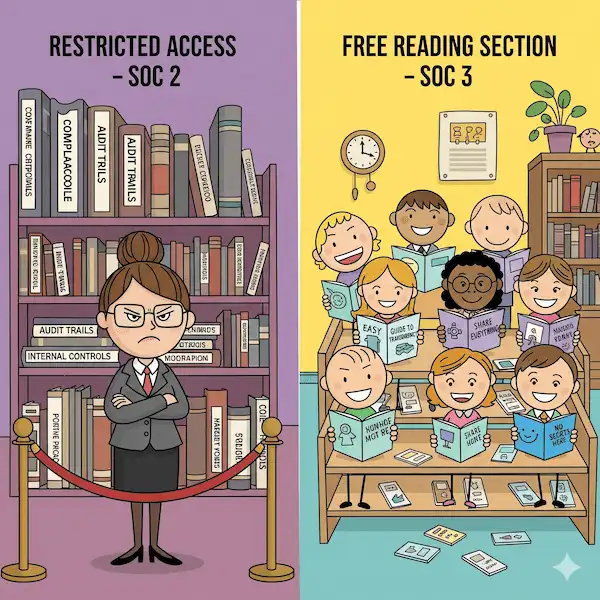
SOC 3 Reports aren’t required. Some organizations choose to use them as a tool to demonstrate system operations to prospective clients where confidentiality requirements prevent sharing more detailed Reports. In these instances, the SOC 3 is useful to help share some of the internal controls publicly, which isn’t possible with the SOC 2.
That is basically it. The key difference is the purpose. SOC 3 Reports are designed for general public use. You can post them on your website, include them in marketing materials, or hand them out at conferences without any NDAs or restrictions.
If you have a process to distribute your SOC 2, and sharing the Report and getting NDAs signed with its readers is not an issue for your company, you likely don’t need the SOC 3.
The SOC 3 is done during the SOC 2 examination and a service auditor will work with your teams to generate a Report. Unlike SOC 2 Reports, which are thick, detailed documents full of control descriptions and test results, a SOC 3 is typically just a few pages. It includes the auditor’s opinion, management’s assertion about their controls, and a basic system description. No proprietary details, no specific control listings, no test procedures.
Why Would You Want Both Reports?
During the same SOC 2 examination process, your auditor can issue both Reports with minimal additional work. They’re doing the same testing, applying the same criteria, and reaching the same conclusions. The SOC 3 is just a different way of presenting those findings, and again, it’s because the purpose of the Report is different.
Why would you want both Reports? Sometimes the dual approach solves a real business problem. Your SOC 2 Report is perfect for enterprise prospects who need to dig into the technical details during their vendor security reviews. But its design is to answer the question, “what about everyone else?”
Say you’re at a trade show and a potential customer asks about your security practices. You’re not going to hand over your 50-page SOC 2 Report on the spot to folks you just met. This is where the SOC 3 comes in. Handing them a two-page SOC 3? That’s exactly what they need to see. Sales references it in first conversations. Marketing puts it on the website. Nobody signs an NDA.
What SOC 3 Won’t Do for You
There’s no such thing as a standalone SOC 3 audit. You can only get a SOC 3 if you’re doing a SOC 2 examination. The SOC 3 is always Type 2 (covering a period of time, not just a point in time) and always builds on the foundation of a full SOC 2 assessment.
It doesn’t replace a SOC 2 Report. A SOC 3 Report won’t satisfy serious security due diligence processes. If an enterprise prospect’s security team is conducting a formal vendor risk assessment, they’ll still request a full SOC 2 Report.
The Trust Services Categories still apply. As alluded to above, it isn’t an easier audit. The SOC 3 is about format because the purpose is different. Just like the SOC 2, your SOC 3 can address one or more of the five trust services categories. The SOC 3 will confirm which categories are addressed and that you have controls that met the criteria, it just doesn’t add the details on what specific controls are implemented (that is what the SOC 2 shows).
Having the SOC 3 will let the general public know you have effective security measures, but readers of the Report won’t learn what those measures are or how they were tested until later on in the process when their interests are more aligned and you are further into the prospective client onboarding phase. In short, a SOC 3 is assurance without the details.
SOC 3 vs SOC 2: Side-by-Side
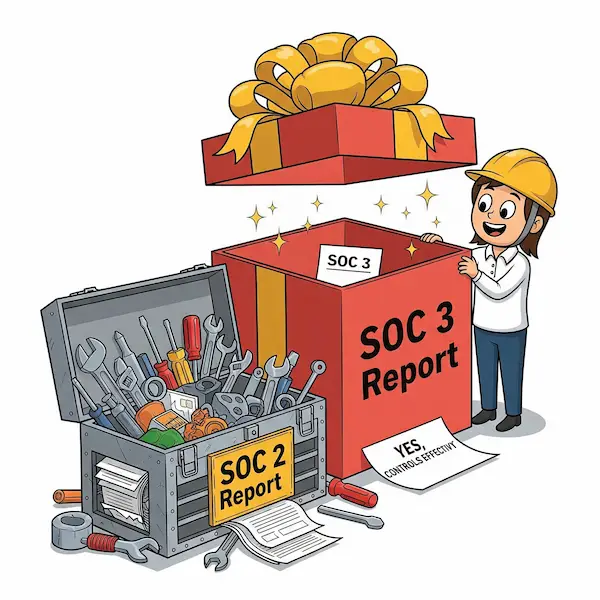
Same examination, same Trust Services Criteria, different Report. Here is the comparison at a glance:
| Aspect | SOC 2 | SOC 3 |
|---|---|---|
| Audience | Restricted: customers and their auditors, usually under NDA | General public: anyone |
| Detail level | Full system description, control listing, auditor test procedures and results | Short summary: auditor’s opinion, management’s assertion, high-level system description |
| Report types | Type 1 or Type 2 | Always Type 2 (no point-in-time version) |
| Standalone engagement? | Yes | No; issued only alongside a SOC 2 examination |
| Distribution | Controlled distribution process | Post it on your website, share freely |
| Typical length | 30–100+ pages | A few pages |
If you need the restricted, detail-rich Report that enterprise security teams request during vendor reviews, that is the SOC 2. Our SOC 2 reporting services page covers scoping, timelines, and what the examination involves. And if you are still deciding which combination of Reports fits your business, the “Do I need SOC 2?” assessment is a quick place to start. And if the request you received says SOC 1 rather than SOC 3, that is a different comparison entirely; our SOC 1 vs SOC 2 guide sorts it out.
When SOC 3 Makes the Most Business Sense
Not every company needs a SOC 3, but it’s particularly valuable if you’re:
Building trust with non-technical stakeholders.
Executive buyers, procurement teams, and board members often want security assurance without technical complexity. A SOC 3 gives them exactly that.
Competing in crowded markets.
Every vendor’s homepage says secure. One of them links to an auditor’s opinion. A SOC 3 lets you back up your security claims with third-party evidence.
Serving regulated industries.
Some sectors have compliance requirements that a public SOC 3 can help satisfy, even if the detailed SOC 2 is what really matters for due diligence.
Targeting mid-market customers.
Enterprise prospects will always want the full SOC 2. Smaller companies often find a SOC 3 provides sufficient assurance for their needs to proceed with further operational considerations when vetting a product.
The AWS SOC 3 Report: A Real-World Example
If you want to see what a SOC 3 looks like in the wild, look at Amazon Web Services. AWS publishes its SOC 3 Report as a freely downloadable document (no NDA and no AWS account required), while its SOC 1 and SOC 2 Reports are restricted and only available to customers through AWS Artifact. That split is the SOC 3 value proposition in action: public assurance for everyone, full detail reserved for the parties who need it under confidentiality.
The AWS SOC 3 lists the in-scope services and Trust Services Categories and carries the independent auditor’s opinion, without control-level detail. You can find it on the AWS SOC compliance page.
The takeaway for your own program: if the world’s largest cloud provider answers “are you secure?” for the general public with a SOC 3 while reserving the SOC 2 for customers, the same two-report strategy works for service organizations of any size.
How to Obtain a SOC 3 Report
A SOC 3 Report can be obtained by hiring an independent auditor from a licensed CPA firm to perform an audit of your controls. Our SOC 3 reporting services page covers what the engagement involves and how the Report is issued alongside your SOC 2.
While your audit may vary based on your control environment and audit scope, the SOC 3 audit process will follow the SOC 2 engagement process. Tell your auditor early if you think you need a SOC 3 Report. Your auditor will be able to assist you with understanding and providing the SOC 3 Report and generally you can receive the two compliance Reports, one for restricted users (SOC 2), and one for public usage (SOC 3), at the same time.
Since the SOC 3 rides along with your SOC 2 examination, budgeting starts with the SOC 2 itself. If you want a realistic number for your situation, our SOC 2 pricing calculator gives you a fixed-fee estimate in about two minutes, based on your company’s size, scope, and timeline. No sales call required.
Frequently Asked Questions
What is a SOC 3 Report?
A SOC 3 is a short, general-use Report produced from a SOC 2 Type 2 examination. It contains the independent auditor’s opinion, management’s assertion, and a high-level system description, but none of the control listings or test results found in a SOC 2. Its purpose is public assurance: anyone can read it.
What is the difference between SOC 2 and SOC 3?
Audience and detail. Both come from the same examination against the same Trust Services Criteria, but a SOC 2 is a restricted-use Report packed with control descriptions and auditor test results for customers and their auditors, while a SOC 3 is a brief public summary with the same underlying conclusion and none of the detail.
Is a SOC 3 Report public?
Yes, that is the point of it. A SOC 3 is designated for general use, so you can post it on your website, cite it in marketing materials, and hand it to prospects without NDAs. The SOC 2, by contrast, is restricted to specified parties.
Do I need a SOC 3 if I have a SOC 2?
No. A SOC 3 is optional. It earns its keep when sales or marketing needs a public, third-party-verified security statement before prospects will sign an NDA. Because it is issued from the same SOC 2 Type 2 examination, adding one is typically a small incremental cost.

At Sage Audits, We Work With You
We know audits can be overwhelming. Our goal is to make the process smoother and less stressful. We stand beside you with practical guidance, not just paperwork.
Whether it’s your first SOC 2 or a renewal, we’re here to help you get through it confidently and with real value. – Jordan Novak, Managing Partner